
How Cormac McCarthy Writes Great Prose (and How You Can, Too)

There are parts of good writing you can’t teach. You can’t hand someone taste. You can’t blueprint instinct. You can’t lecture a person into picking the right word at the right moment, the way great writers seem to do like they’re pulling it from the air.
But there are things you can teach.
You can teach structure. You can teach rhythm. You can teach how sentences behave on the page. How they build pressure, how they release it, how they create momentum or stillness, how they turn description into something musical. Sublime prose—that unapproachably good selection of words into an order that feels just right—is often built using a combination of technique and skill.
The technique is called writing craft. That’s the part that can be taught. And Cormac McCarthy in All the Pretty Horses writes a passage that shows how craft + style creates sublime prose.
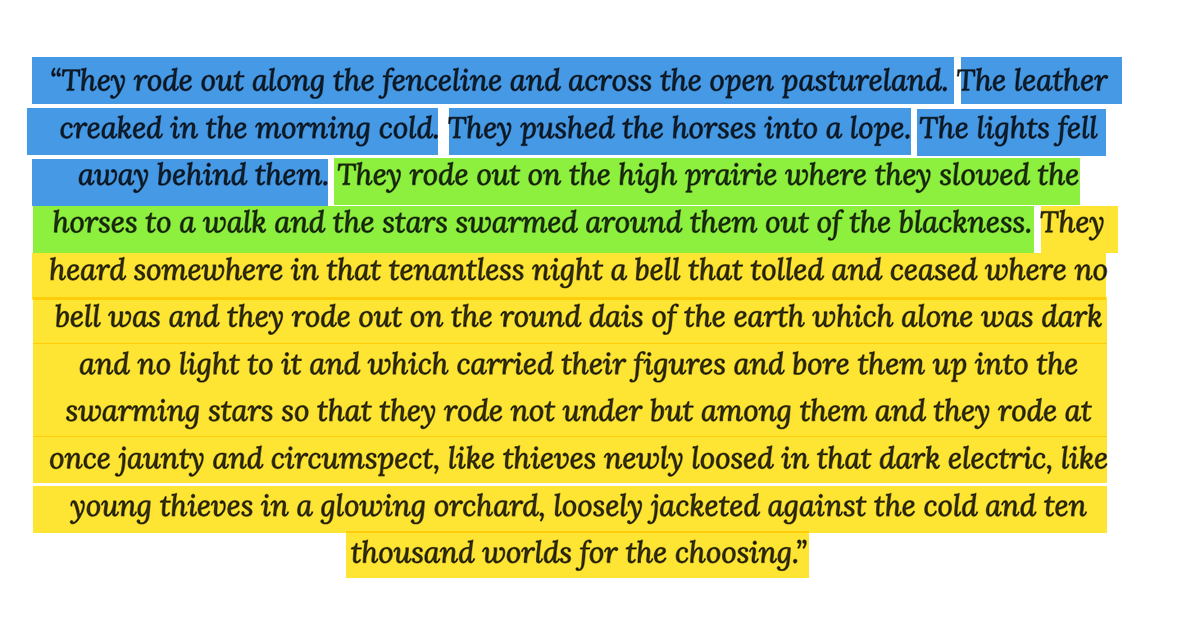
“They rode out along the fenceline and across the open pastureland. The leather creaked in the morning cold. They pushed the horses into a lope. The lights fell away behind them. They rode out on the high prairie where they slowed the horses to a walk and the stars swarmed around them out of the blackness. They heard somewhere in that tenantless night a bell that tolled and ceased where no bell was and they rode out on the round dais of the earth which alone was dark and no light to it and which carried their figures and bore them up into the swarming stars so that they rode not under but among them and they rode at once jaunty and circumspect, like thieves newly loosed in that dark electric, like young thieves in a glowing orchard, loosely jacketed against the cold and ten thousand worlds for the choosing.”
All The Pretty Horses, Cormac McCarthy.
First, Structure (Craft)
Good prose is many things, but it’s also like comedy. It’s a series of setups and then a payoff.
In this section, McCarthy gives us quick setups:
“They rode out along the fenceline and across the open pastureland. The leather creaked in the morning cold. They pushed the horses into a lope. The lights fell away behind them.”
These four sentences are movement; they’re similar in style and word-length. They’re setting you up for a right-hook of a sentence, and without realizing it, you’re expecting a change. So when McCarthy gives it to you, it sets off neurons in your brain that go, “That’s nice.”
“They rode out on the high prairie where they slowed the horses to a walk and the stars swarmed around them out of the blackness.”
Still movement, but not the full release of tension you’ve been expecting. The first four sentences are a staccato 11, 7, 7, and 6 words. This new addition comes in at 25, but it’s nothing compared to the rhythmic release that will follow:
“They heard somewhere in that tenantless night a bell that tolled and ceased where no bell was and they rode out on the round dais of the earth which alone was dark and no light to it and which carried their figures and bore them up into the swarming stars so that they rode not under but among them and they rode at once jaunty and circumspect, like thieves newly loosed in that dark electric, like young thieves in a glowing orchard, loosely jacketed against the cold and ten thousand worlds for the choosing.”
Without mentioning what McCarthy is saying, the rhythm of how he delivered it is already so pleasing that whatever words he used are going to be received better because the music of them feels right.
This is where the poet comes out. Where Cormac does something that only he can do.
Second, Style
McCarthy often will conjoin words together, refuse punctuation where he can, instead opting for conjunctions. He also often uses a technique where he gives closure to a metaphor. Most writers leave you with the image, but McCarthy likes to capitalize on it.
They heard somewhere in that tenantless night a bell that tolled and ceased where no bell was
Most writers would write: They heard somewhere in that tenantless night a bell that tolled and ceased.
But McCarthy adds “where no bell was” as a stylistic choice. It feels wrong; nobody speaks this way on purpose, but it works because it draws attention to itself. In contrast to his Spartan dialogue, he’ll peel back the onion on imagery and feeling. That contrast, like his sentence choice variation, often creates a similar rhythmic catharsis in the reader.
He finishes with a chain of similes that also repeat.
they rode at once jaunty and circumspect, like thieves newly loosed in that dark electric, like young thieves in a glowing orchard, loosely jacketed against the cold and ten thousand worlds for the choosing.
Breaking this passage down more specifically, it looks like this:
Core clause chain:
They heard …
… and they rode out …
… which … carried … and bore …
so that they rode …
and they rode … (with modifiers)
Simile Cluster:
After circumspect, the sentence enters a descriptive tail made of comparative phrases and modifiers.
“like thieves newly loosed in that dark electric”
“like young thieves in a glowing orchard”
Then, to finish, McCarthy used a tool often associated with his prose: an intentionally unbalancing elliptical coordinated phrase:
“and ten thousand worlds for the choosing”
Quick takeaways for writers:
Rhythm
This is what the passage could have looked like if it lacked the same sentence variation:
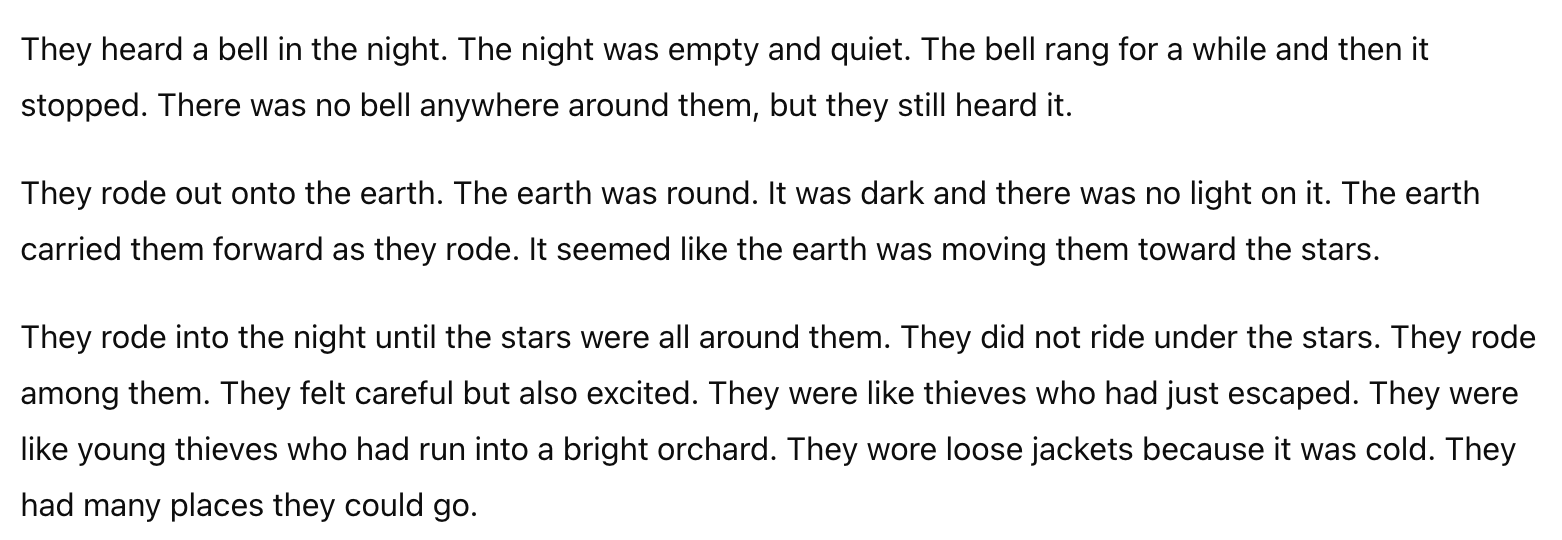
While the visual imagery used gives this passage its electricity, the structure of it is what separates it. The boring version lacks the clause contrast that we get with McCarthy.
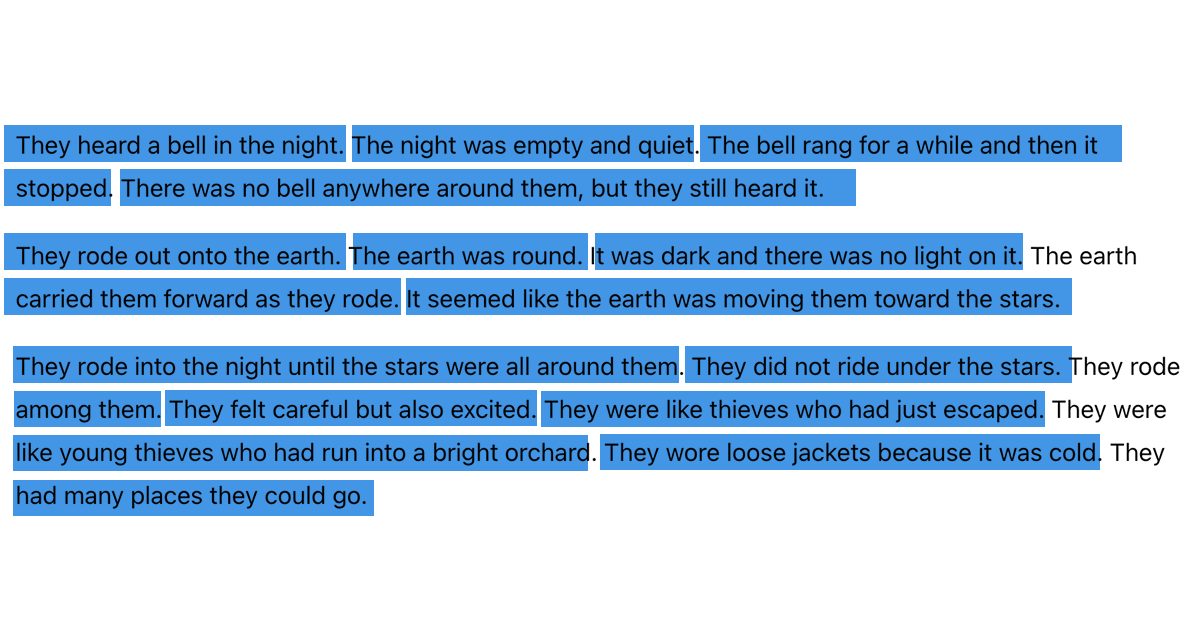
Intentional Breaking of the Rules.
McCarthy’s seemingly run-on sentences would set off the grammar police. But he does it intentionally to create a feeling, and it works. It works a bit like a montage sequence in a movie; one thought flows into the next with such ease that you hardly realize there’s no comma because the effect is kaleidoscopic and cool and satisfying and you’re breathless at the end of it.
Gut Feeling
Many of McCarthy’s choices were developed over years of writing and honing the music he wanted to hear from his words. Often, you hear that in order to be a good writer, you have to write a million words to ‘get the crap out’. But getting the crap out is another way of saying that you’re refining your ear for prose and your taste.
Choices like “tenantless night” and “a bell that tolled and ceased where no bell was” and “they rode at once jaunty and circumspect” and “like thieves newly loosed in that dark electric, like young thieves in a glowing orchard” are all tools (stylistic choices) that McCarthy added to his toolbox.
You won’t hear in an MFA course that you should conjoin words, call attention to absence, or repeat phrases, but all three of those things are used to create an image in this passage, and to create a hundred more like it throughout the novel.
Right on partner..., write on.
My favorite passage is from "The Crossing"..., and after 20 some years it still takes my breath away:
He camped that night on the broad Animas Plain and the wind blew in the grass and he slept on the ground wrapped in the serape and in the wool blanket the old man had given him. He built a small fire but he had little wood and the fire died in the night and he woke and watched the winter stars slip their hold and race to their deaths in the darkness. He could hear the horse step in its hobbles and hear the grass rip softly in the horse's mouth and hear it breathing or the toss of its tail and saw far to the south beyond the Hatchet Mountains the flare of lightning over Mexico and he knew that he would not be buried in this valley but in some distant place among strangers and he looked out to where the grass was running in the wind under the cold starlight as if it were the earth itself hurtling headlong and he said softly before he slept again that the one thing he knew of all things claimed to be known was that there was no certainty to any of it. Not just the coming of war. Anything at all.
Fun post!
I think the repetition of ‘they rode’ ‘they pushed’ ‘they rode’ ‘they heard’ ‘they slowed’ ‘they rode’ ‘Like thieves’ ‘like young thieves’ Gives us a sense of the passage of time almost like the verbal equivalent of jump cuts in a TikTok video. It’s like: ‘and now’ ‘and now’ ‘and how about now’
And of course the imagery within it is incredible
You’ve convinced me that I need to read some Cormac. I tried The Road a while back but it was just *too* bleak. Any suggestions on where to start?